MADRID
Our trip began in chilly, rainy Madrid. We stayed at Husa Paseo del Arte Hotel, just across from the Atocha train station. The location was ideal, across from Centro de Arte Reina Sofia, a brief walk from the Prado and a 15-20 min. uphill walk to Plaza Mayor. Of the various museums we visited, my favorite was Reina Sofia, home to Picasso’s Guernica, many Dalis and other modern Spanish art.
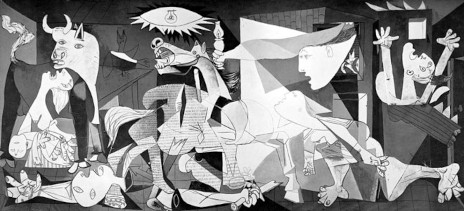
Guernica (above) captures the 1937 bombing raid on the civilians of Guernica in northern Spain in Picasso’s cubist style. Reina Sofia had an interesting presentation of Guernica – not only did you see the huge canvas, but there was a photo record of the painting’s evolution and a hall of studies for Guernica. A nice behind-the-scenes peek at the creation of a masterpiece.
I also really enjoyed the Royal Palace (Palacio Real). Particularly compared to Versailles (which seemed bland, expansive and empty), the Royal Palace was vibrant and full. Awesome ceiling frescoes and uniquely neat rooms – one was all porcelain and there was a smoking room that was Chinese from head to toe. We also visited Museo Thyssen-Bornemisza, the Chapel of San Antonio de la Florida (home to many Goyas and his final resting place) and the Prado. I learned what an art lover my husband really is on this trip – I don’t care much for classic paintings, but he was in heaven. Not many pics from Madrid as most of the sights did not allow indoor photography.
 On our final day we caught a Real Madrid match and I was struck at how calm a stadium of 80,000 fans could be. Real Madrid killed Osasuna 7-1, but it was exciting to see a game with a lot of gooooools. Renaldo scored a hat trick (Kev's contribution to the blog). Osasuna had one bogus goal – one of the players was down with an injury so another player picked up the ball (basketball style), then while players were distracted waiting for a call, the player with the ball raced near the goal, dropped the ball and booted it in. SportsCenter-worthy, this crazy play! There was a cheer-leading section near one of the goals that started most of the call/response chants and it was fun to watch their various cheers (one was all jumping, one seemed to be dancing, one was with scarves). We ended up with maybe ½ a day too many in Madrid – nice for downtime, but I think 2 full days in Madrid (vs. our 2.5 days) would have been just right.
 For breakfast we mainly ate churros dunked in warm chocolate (the consistency was somewhere between hot chocolate and pudding). The two places we tried were Chocolateria San Gines (crunchier churros, thicker chocolate) and Chocolaterias Valor (doughier churros and thinner but robust chocolate). For every other meal, tapas are king in Madrid. Mercardo de San Miguel is a real treat for those uncomfortable with the “tapas crawl”. The mercado is a covered market from the 1900s that now features high-end food vendors. It’s a treat to walk around and the easiest tapas crawl you’ll ever do. We started with chorizo paella and then hit the chartucherie for a cone of sliced salami. We next tried the skewer stand for tomato/mozzarella/pesto and tomato/cheese/jamón ibérico(from “pigs who live stress-free lives in acorn-strewn valleys”). From the seafood stall we ordered a tuna/red pepper canapé and a mixed seafood canapé on a fried tomato slice. We could have kept going… there were a bunch of other stands running the gamut from sushi to baked goods to oysters. Wine is also everywhere so I can see this being a fun outing for the wine drinkers. Just two days later the Today Show was in town filming “Where in the World is Matt Lauer?” at this very market!
 The two main tapas restaurants we went to were recommended as part of Rick Steves’ Madrid Pub Crawl (for Beginners) on Calle de la Cruz. We first tried Casa Toni, where we stuffed ourselves with patatas bravas (fried potato chunks with a spicy sauce), pimientos de padron (sautéed, salted little green peppers), berenjena (fried eggplant slices with a sweet sauce) and a skewer of grilled pork. We also tried Oreja de Oro, known for their sautéed pigs’ ears, our most adventurous meal of the trip. Sure, there were little cartilage bits and little furry bits, but the fatty bits just slightly crispy on the outside were awesome. Ice cream tapas? Sure thing! We dropped in on Giangrossi Helado Aretsanal for a degustation of five ice cream flavors (we tried dulce de leche, hazelnut chocolate, lemon meringue, Marie biscuit with caramelized milk and yogurt with honey/walnut) each served in a small waffle cone bowl. We did break from tapas occasionally with bocadillos de calamares (fried squid sandwiches) at Casa Rua and El Brillante and a cheap picnic with fresh bread and various cured meats and cheeses from Carrefour (near the Lavapies Metro).
TOLEDO
 We took a day trip to Toledo from Madrid – only 30 min. by train (~18€ round-trip). We started at the Cathedral – expansive and elaborate. Some European churches are big – this church not only had a vast interior, but it had a variety of side chapels and rooms that really rounded out its grandeur. The high altar is vertically huge and extraordinarily detailed. We paid 3€ extra to hike up the steeple, but unfortunately this only bought us up to the bell tower (200 or so steps) with no real view to speak of – skip it. A few sights in Toledo feature the work of El Greco (1541-1614), a Cretan painter who settled in Toledo. Kev really liked his style but it reminded me of religious black velvet paintings (quite the art connoisseur, aren’t I?). On this trip, a first for our travels – a bunch of free museums! Some, like the Santa Cruz Museum (home to 15 El Grecos) are always free, while El Greco Museum and Sinagoga del Transito (Museo Sefardi) are free in the afternoon. We also visited Santo Tome (home to one El Greco “left in situ, where the artist placed it 400 years ago”) and Kev dropped in on the San Juan de los Reyes Monasterio where he was most excited to photograph a stone relief of a monkey on a toilet (no lie) and the chains dangling from the exterior. The chains have a neat story to them – they are 500+ years old and were used by Moors “to shackle Christians in Granada until 1492. The freed Christians brought these chains to the church, making them a symbol of their Catholic faith.”
 We had a great lunch at El Trebol with a trio of tapas (tomato and tuna salad, prawn croquette and ribs), patatas bravas and a trio of bocadillos. On the walk out of town, even though it was raining, there was an incredibly vibrant sunset in the warmest shades of red, orange and purple. Pair this with the green/burnt orange landscape and it was just gorgeous. Rick Steves advises pre-booking your trains so we booked the first and second to last trains of the day. Our trip home was at 9:30pm and we felt we had done all that could be done at 6:30pm. We headed to the train station on the hopes that we’d be able to sneak on to the earlier train, but fortunately we didn’t need to be sneaky as they gladly exchanged our tickets for an earlier train.
SEVILLA
From Madrid we caught an early train to Sevilla. Upon arrival in Sevilla it appeared something was fishy with the cabs as there was just a sea of empty cabs with no drivers – the policeman told a group of us in the taxi line to head across the street to a hotel to hail one. We do so, and for the first time we think we were given the “scenic tour” where the cabbie took advantage of us not knowing the direct route and just ran up our fare a bit. Not a super big deal, but it started Sevilla off on a sour note for us. We dropped off our bags at our hotel – Hotel Amadeus – and headed straight to the Cathedral and Giralda Bell Tower.
The Sevilla Cathedral is the world’s largest Gothic church – the third largest church in Europe, built on the site of a mosque in 1401. The Toledo Cathedral’s high altar was ornate, but Sevilla’s high altar takes it to the next level – just outrageous in terms of height and detail. The church also features the elaborate tomb of Christopher Columbus. The trip up the bell tour was quite neat – they had a ramp that spiraled up. This was designed for the horseback riders “who galloped up five times a day to give the Muslim call to prayer.” Entrance into the Cathedral also has a combo admission for Church of the Savior (Iglesia del Salvador), the second largest church in Sevilla.


We had a blah fried fish lunch and then toured Alcazar, a palace “built by the Moors in the 10th century, revamped in the 14th century.” The first level of Alcazar features lavish tile mosaic work from the ceilings down to the floors. I can’t quite think of how to describe the second level, but it is definitely much less Moorish and more Euro-regal. Alcazar has an elaborately planned garden courtyards and we enjoyed sneaking up to several peacocks that roamed freely.


We spent the afternoon meandering, first through the Plaza de la Encarnación to see the Metropol Parasol. I had seen photos of this public area and knew it was in Spain, so I was excited to find out that it was in Sevilla. The public square is canopied by a wavy waffle-like tree structure and for a small fee we were able to walk on top of it (which is not mentioned in the guidebook but was pretty neat).
We walked to the Basilica de la Macarena, which features a “Weeping Virgin” with crystal teardrops trickling down her cheeks, though I must be blind because I could not see them. This church echoes a style we saw at a lot of the Spanish churches – mannequin-type saints in clothes at altars. We then walked along the river path (lined with fantastic graffiti and full of runners) and through the shopping areas of Santa Cruz (Calle Tetuan, Calle Sierpes and Calle Cuna).
 Since Sevilla is home to flamenco, we decided to jump on the tourist bandwagon and see a flamenco show. Ricardo recommended Casa de la Memoria de Al-Andalus and there we enjoyed a singer, guitarist and dancer. Having seen a lot of flamenco costumes while shopping, we were expecting polka dots, castanets, shawls and fans but the show was quite reserved and serious. The singer/guitarist performed a few songs and then the dancer appeared in a decidedly non-polka dot costume for several intense, rapt performances. The one hour show ended at 10pm and we opted for a light dinner of tapas at Bodega Santa Cruz – tasty albondigas (meatballs), fish in a zippy adobo, a chorizo croquette and pork chunks.
Photos from this portion of our trip are up on Facebook.


No comments:
Post a Comment